Tuesday, 25 February 2014

Light bulb!

After a few weeks pondering away about my various categories of inquiries, something clicked...


The other day I was watching a performance all to recorded voices of different people’s memories. What struck my attention especially was one guy who was talking about why he danced, and why he keeps on going strong… I thought YES this would be perfect as an inquiry topic! Why do dancer’s dance, what stimulates them?
What is also intriguing is what dancers do in order to keep themselves going? 
Originally I was going down the line of well being of a dancer, however I thought I could incorporate it all together. There are numerous physical and mental aspects and preparations of a dancer’s life to help them move forward, keep going strong:
  • Keeping fit
  • Keeping healthy
  • Eating right
  • Having the right mind set/ mental attitude
  • Keeping motivated and happy
I want to know how to maintain all of this? And why do dancers dance, what is that stimulation? 

Sunday, 23 February 2014

View from the Sidelines

The week of the Cape Town International Competition has come to an end, and wow what an experience it has been!
Unfortunately due to injury I could not participate, however I was still well involved in the whole event. On the first day I came in to let them know I couldn't dance, ending up helping out and for the whole week. Without realizing it, it lead me to be a runner for the director and all the judges where I saw it all from a totally different perspective; from the sidelines.

Whilst watching behind the scenes, all the shows, observing the competitors on and off stage, getting the scope from the judges point of views and how they operate during a competition I got a clearer understanding on how it is all perceived by the top, how it all works.


Competitiors:

  • Watching from the side, during rehearsals there were a lot of nerves coming from most dancers -full on apprehensive vibes. It was interesting to see how on stage they suddenly lit up,  performed a whole lot better than in the rehearsals. It was a different take to in a company, where most perform a lot more in rehearsal. 
  • I realized it was treated quite a lot like a sport- rehearse and train, repeat loads for one chance only, especially the international coaches were very strict on every minute detail of the dancers' technicalities, almost groups/teams from the different countries, quite a few were just focused on how they looked and on the steps rather than the performance.
  • Overall a friendly competition, where a lot were there for the fun and experience of it even though there were medals to be won.

Judges point of view:

  • A lot more relaxed than I ever expected. They were all lovely, and i thought had the right intentions towards the end results. 
  • Although there is the general marking, they all had a rough idea from day 1 who would go through or not to the next rounds. A lot of it relied on opinions and general liking rather than just on the pure marks, where there was a bit of leeway to the marking system if they wanted another dancer to go through etc.
  • Unlike a sport where the end result relies on a certain time or number, artistry was considered. They made a invaluable point about the general training here in South Africa where they have talent, but there isn't that proper fines to their training, where they needed to work more on the upper body… interesting!
  • Mentioned what they look for in contemporary, mainly wanting to see more movement and contemporary techniques. Although the acrobatic tricks were impressive to the audience, and the constant falling to the knees and rolling through the feet, they wanted to see more dancing rather than just up and down. They also mentioned how it is harder to define what is contemporary dance these days as it is a too vast spectrum of styles.


They were also discussing maybe getting variety of dances to choose from rather than choosing anything so to see if someone has a lack of coordination or faults, therefore easier to mark. This really took me back to thinking how competitions treat dancing as a sport, focusing more on how well it is done. They made a good point of how it runs like a business in someways where they need spectators. They would get bored if they saw the same dance over and over again, therefore money would be lost. Is it better to please the audience or judges in competitions?

From an audience point of view this was the most interesting! The audience rave on the tricks and high legs! Anything impressive, they love. Yes I am sure the general audience would appreciate a beautiful white swan variation, or dying swan but what wins them over are how many pirouettes a guy does in the fiery Don Q solo, how many double fouettes from the girl. Yes it requires huge skill and all the best dancers of the world can probably do this, but it does not define a good dancer. Everyone is so individual, and if they can captivate the audience through their movement then they have done their job.

Overall it was a great week, hard at times, but an eye opener to what is out there for me and the country. That is what is great about this compeition, trying to merge that gap between the international and national dancers and I am sure in years to come it will improve. To be exposed to this whole other level has been great, to see the tricks of the trade and artistry of a whole nation of dancers. I was so proud of all the South africans who participated as well, and I hope this improvement will continue to grow.


Wednesday, 19 February 2014

Task 4b- Special Interest Groups


The bottom line is, generally dancers dance because of enjoyment, otherwise they would not put themselves out there to train long hours, perform till late, where they will do their utmost to develop as an artist, and just keep on dancing. I believe the vitality of a dancer is what is key to the utmost enjoyment of this demanding yet most exciting lifestyle. 
This is why I would like to discover a lot more about the mental and physical aspects towards a dancer's general well being, so to help them have the best and longest career they can possibly have. 
Having always been interested in nutrition, keeping fit and healthy, I would like to explore these topics more in depth to bring out a meaningful inquiry.

After finally grabbing the concept of developing an SIG, I have found a quite a few fellow BAPP students on the same line of inquiry towards the 'health and fitness' as well as as 'psychological' route towards dancing.

Heather Smith caught my attention on her narrowed down questions to the pressures of the dance industry. This is what 'makes or breaks' dancers. There is a lot of pressure on a dancer to be their best in order to succeed, but from the outside perspective it is a visual art where the audience generally don't know what hard work goes into it. The physical side and issues of dance is being addressed to more often with all the new scientific researches on how the body/muscles reacts to certain diets, exercise programs etc. but I feel the mental side is neglected at times. Pressure affects this, and it is something I would like to know more about and am sure other dancers would too!

As well as Megan Lewis posting about Dance Psychology week on Dance UK, some of her inquiries struck some interest. One was asking about generic weaknesses in dancers linking to age and genes. and whether it creates faults. This got me thinking what would help with overcome these weaknesses in  their dancing- exercises, strengthening, certain diets?
Her other inquiry related to trigger point therapy, which I know helps with balancing the energies of the body and mind. Something that could link to improving in mental well-being? 

Emma Price has similar questions towards health and fitness. What got me more enthusiastic was her question about where we can gain specific information for dancers? There is general basic information out there, but to go more in depth, personally I have found it difficult to find certain things. Instead we are often having to discover things for ourselves, all about trial and error. Sometimes if there was a bit more of a guidance on what can be done to help us develop as a dancer to our best, that would be great. 
Emma also picked this issue up:
Reading Gabrielle's posts I can see the health and fitness theme is similar to that of my own thinking. Asking what does it take for a dancer to be fit and healthy physically and mentally and how do you keep a balance of strengthening muscles yet staying lean. All these are questions I have asked myself throughout my training and career & I find a lot of information about sports related fitness programmes whereas less that are specified to dance. My boyfriend is a professional footballer & the amount of time and money spent on injury prevention and rehabilitation programmes in a professional football club compared to most professional dance companies is astounding. Obviously football has a lot more money to spend than the arts however even just the importance stressed in their education on nutrition & daily gym training/workouts compared to in dance is huge. It means they get into eating/sleeping/training routines from a young age that they then maintain throughout their career. My routines have often changed due to me testing things as quite honestly I was never thoroughly educated in this side of my profession.

There are some other BAPP students like Rohanne Compson Bramford on pressures of dance, and the effects of injuries (something that frustrates me so much as dancer myself!) and Laura Houghton who have shown interest in related topics to mine.

I would like to create a couple of SIG groups via Facebook as I thought it is very easy and accessible. I am also going to create tags on my blog, posting about the different topics. Please let me know if you would be interested in joining my SIG and feel free to comment on my upcoming posts...

Friday, 14 February 2014

Inquiring even further...

In the midst of a real transitional phase of my life, traveling, nursing an injury, I have been able to develop my inquiries even further. An to have the pleasure to reflect in my home country, in the beautiful Cape has helped tremendously!

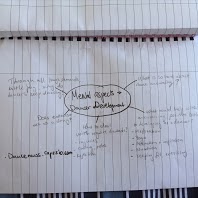
After a long Skype with Paula, a few inspiring ideas came to mind. While explaining to her about my ideas for my professional inquiry, it became clearer on what I wanted to do. I first had a mishmash of things to do with nutrition, health and fitness, physical + mental aspects of a dancers life. She suggested I made a few pages of notes on each topic and so I decided to create some spiderwebs diagrams:


Looking back on task 2d, it all related to my enthusiasm of well being as a dancer. In addition I discussed overcoming injuries, casting decisions, rejections as well as finding inspiration to discover explanation on why I love what I do.

What has now come to mind was how all these discussions and questions have linked together: the general inquiry about how a dancer's well being, mentally and physically, leads to development within their dancing and profession.

I was encouraged to research, actually google some of these topics, and a few interesting sites have popped up:

And what got me especially excited was Megan Lewis's post on Dance UK with their Dance Phsycology week. This website has loads of intriguing stuff all over! Looking forward to crack on...

Friday, 31 January 2014

Questions- Artistry v.s Sports

Sport/Artistry:

  •  Is ballet considered more of a sport than an art?
  • How much is artistry taken into consideration putting productions on/auditioning new dancers etc.?
  • Is there a balance between the two?
  • Is it more important to be technically strong and perfect or artistic and interesting/unique?
  • Does keeping a good physique contribute to dance being considered a sport?

Questions- Nutrition

Nutrition

  • What types of foods should dancers eat more of and/or avoid?
  • What should their type of balanced diet be?
  • Does being a good cook help with preparing healthy and nutritious meals?
  • What foods and diets help maintain a fast metabolism?

Questions- health and fitness

Health and Fitness

  • What does it take for a dancer to be fit, athletic, graceful, lean but powerful, healthy not just physically but also mentally- what could be the right balance between all of this?
  • How to keep a balance between strengething muscles and keeping supple?
  • What helps to lower risks of injuries?
  • And what food/exercises/way of thinking helps to recover?
  • When is it best to practice, exercise and rest?
Mental Aspects:

  • What are the mental affects from training as a professional dancer?
  • What lines of practice will help with the mental side of coping as a professional dancer? Yoga? Meditation? Dance Psychologists?


4a- Developing Lines of Professional Inquiry

Starting a new module brings in development, improvement and new knowledge. Having to inquire about my work practice has not come at a better time, being in the midst of a transitional phase with dancing myself.

Reading reader 4 has been quite hectic trying to grasp everything. What I have obtained is that the ultimate goal for this module is to explore a topic that will benefit my work and the work of colleagues, fellow professionals etc. It will in turn help identify my own unique learning.

As mentioned earlier, I have always been pretty interested in the whole health and fitness side of dancing, where I believe the vitality of a dancer is what is key to the utmost enjoyment of this demanding yet most exciting lifestyle.
There have been a fare few questions that pop up daily in my thoughts, and so I have organized them in the following posts to come… feel free to read on...

Wednesday, 22 January 2014

Thoughts in action

Thinking about the next steps for the following module, leading into my professional inquiry has obviously got me thinking on what I really ask myself, what I really want to know more about in my profession as a dancer.

Something that keeps popping up is my interest in health and fitness, and hopefully this might turn into something interesting? For now here is a video clip I stumbled upon which fitted quite nicely with my thoughts:

http://m.youtube.com/watch?v=j0PAbJq0eHA&desktop_uri=%2Fwatch%3Fv%3Dj0PAbJq0eHA

Sunday, 29 December 2013

The truths about being a professional dancer

In the process of writing my critical reflection, I have gained an immense amount of information and knowledge so far from the course work and from working as a dancer.
It is so difficult to summarize everything and am finding it challenging to clarify  the most important points, but then...I came across this!
http://theportlandballet.org/15-truths-professional-dancer/


It pretty much sums up everything I have experienced and learnt so far, inspiring me even more to keep following my goals!


Saturday, 21 December 2013

Task 3C- My sources of information

My sources of information


When I began to think about the methods in which I gain information from, I found it quite hard to distinguish/categorize which were the main sources I use. Retaining information, learning and experiencing happens most of the time either consciously or subconsciously.
Reading back on Emma's and Megan's blogs, they influenced me to start off with a mind map. This helped tremendously in clarifying the main sources I use within my professional work practice, in order to learn and grow. I realised how often I, and others, use these methods as well and so frequently!

Internet 

Youtube: Dance is a visual art in many ways, and to have it's attributes accessed to via the internet helps to gain information on what is out there. Most companies post videos on their works, upcoming productions and new choreographies (for choreographers). Video is also a great source to refer to when learning a certain repertoire/ choreography as well as obtaining different perspective from the eye of a 'viewer.' Learning from watching can be just as important as doing. It is perfect for inspiration as well, either for motivation, or choreography etc.

Google: The easiest way to retain information on just about anything. However the first link that pops up may not be the best source, therefore proper researching I think needs to be taken into consideration. Wikipedia is always 

Websites:
Dance Companies- a way to retain information on history/background of companies/ dancers/ choreographers etc. Another way to see what is out there.I frequently check http://www.justlivedance.com, to keep updated. Being part of it, I believe it is important to know about the company in detail .  

http://balletnews.co.uk- Can't put it in any other words than to say that Ballet News is awesome! It is a website/blog that posts the current news in dance around the world. It is all through posts on their main page, highlighting the top stories with links to more detailed articles. In addition they have posts (and some categories) of videos, photos, interviews with dancers and nutritionists. I find it is like the BBC of the ballet/dance world. A great way to keep updated, learn from different practitioners and what is going on.

Social Media

Facebook- Easiest, most effective way to post about present whereabouts and updates on what people/ certain artist groups/ dancers are doing. This is done via Facebook pages, e.g viewing current information on https://www.facebook.com/JuStLivedaNce, or Ballet News posts. Photos are instant messages as well as normal messaging. It is basically a fast way in retaining information, and connecting.

http://www.networkdance.com- Network Dance is such a useful website, but categorised it under social media for the fact that, even though similar to ballet news, as an individual you are able to be more active and interactive with others through the site. Setting up my own C.V and photos has helped me learn how to set up a base for my network platform. Videos and other links are available to be posted and seen by others too. When auditioning, it is a great site to help with this because they post most auditions up

Blogs-Being able to blog your thoughts plus view other blogs on the BAPP course has really helped me get through all the tasks. By interacting with one another, giving advice and gaining advice etc. has taught me more about the topics that is raised in each task. I find everyone has given inspiration and ideas on how to move forward in the first module, and I am looking forward to the next two to see what else there is to learn. Commenting and critically reflecting has been a huge helps in distinguishing what to improve and other points to think about (e.g Paula's comment on critical reflection on reflective practice)

Social Interactions

When there is a sound relationship formed between individuals, through their interactions it is pretty certain that knowledge is shared with one another: 
Colleagues and friends- give advice and opinions on current work, corrections, injuries, even what style of dance-wear suits each other. They are always there to help each other out and work as a team to create a good working atmosphere.
Teachers, directors and choreographers- via training and correcting, it is obvious that information is retained on how to improve. But teachers, and especially directors, not only correct but share their own experiences by passing them down on their students/dancers to help them develop. The teachers that have been more close to me have been my mentors, my guardian angels in guiding me towards my goals.
Artists and practitioners- gain information from their own perspectives and opinions. For example, I had a sports massage/ physio (Phil) who helped so much in maintaining healthy strong muscles giving advice on strengthening and healthy eating. His perspective on dancers' health and fitness was very interesting and different, where I learnt a lot of new information.

Experience

Taken from Task 2c,'... experience is needed in order to gain knowledge.' I believe it is one of the most powerful sources of information that really develops an individual in their work...and in their life.

I have learnt so much from performing in shows. Through the years stage presence was developed, how to carry on when something went wrong I learnt the hard way, professionalism and calming nerves I learnt especially from dancing with BRB and Northern Ballet, and now with JSLN.
Participating in workshops is always a great way to learn from other teachers and dancers. For example, I took part in the Prague International Ballet Masterclasses which is a huge ballet summer course held every year in Prague and directed by Daria Klimentova. Through her connections, she is able to bring in so many famous directors and dancers to teach throughout the two weeks. It was such an inspirational course learning from all these most amazing dancers who passed down their experiences directly to you- such a treat!
 

Written Work

Journal- Writing down what has happened, then reflecting on it helps to gain information on how to resolve certain situations or clarify certain experiences. To find meaning behind those experiences is the point where knowledge is gained. 

Dance Europe- Dance Europe is the most amazing magazine giving insight in the major dance news around the world. There are many dance articles, photos, advertisements on auditions and courses with interesting debates and issues that are discussed. It is such a great thing to absorb information from and travel into another world.


Monday, 16 December 2013

Task 3b- Professional Networking


Task 3b


When first starting on the topic of professional networking, I understood it as a way of branching outwards to other work related practitioners, connecting and building up good contacts/ relationships to help in further opportunities within your own professional practice, whilst maintaining a good professional reputation.
By studying Reader 3 with the different theories on cooperation, affiliation and social constructionism, connectivity and communities of practice, it explained more in depth to what extent networking entails. With the use of different technologies/methods, it led to show how much it could benefit an individual to succeeding in their career.

There is a fine line between professional and personal relationships within a networking field and in your own personal working field. I think a balance between the two is something that needs to always be considered and strategically thought through. This in turn links to Axelrod’s idea of ‘cooperating until the maximum benefit’ to then ‘defect.’ To cooperate, work side by side with other practitioners whether they are your colleagues, teachers, directors with other choreographers etc, there is this certain relationship that is formed to be able to benefit from one another. Regarding the Prisoner’s Dilemma game, it allows the players to ‘achieve mutual games from one another’ ‘allowing one player to exploit the other’ or otherwise it gives a possibility of ‘neither cooperating.’ (Axelrod, R. 1984 pg vii) It’s concept brings up a good point of how real life interactions work in many industries where there is this need to be strategic with other contacts in order to move forward, going to the extent of exploiting others.  The idea of defecting afterwards I don’t agree totally with, where I believe there is a certain humble reputation that should be kept in order to sustain a good networking base. As I said it is ‘all about connections’ and ‘who knows you!’ (Task 3A)

Taken from the social affiliation model, the principle of homeostasis suggests that regarding the desire to affiliate, “people control their level of contact with others to keep it stable and as close as possible to a desired level.” (O’Conor & Rosenblood, 1996) Could this be a solution in keeping the balance of personal v.s professional interactions?

Co-operation is a necessity within the dance and performing arts world. Without equal or certain inputs of effort from all sides, the final product (production, dance piece, project) would not be produced. The process in putting on a production, take for example a ballet, requires trust, commitment and cooperation between the director, dancers, teachers, choreographers, stage crew and other practitioners involved. To be able to have all this work done smoothly, there consequently requires a good affiliation with one another in order to be able to gain each other’s benefits to the max and use the values learnt to be able to cooperate.


Researching about social anxiety, what resonated with me was the fact that it can ‘lead to negative behaviors that elicit negative reactions from others and lead to the avoidance of social situations.’ Something I have recently learnt is that there needs to be a certain positive energy as well in order for any sort of process/work to continue in operating and growing. The company works hugely on each other’s energy, especially during performances. When there is a connection that is when the performance comes together. If not, and even if the steps are executed well, there is this empty feeling for the audience. Any dance company is always looking for new contacts, and possible sponsors in order to keep running. Without dance companies, the arts industry could not be whole. Therefore when this vibe of passion and love of the arts is created, this contributes to sending out good energies towards the general audience and whoever might be there. They want a good product that is worthy of supporting, and so in order to network and reach out, a positive atmosphere is a big factor to help develop a sound relationship and future networks with sponsors, certain contacts, dancers, choreographers and even the audience!

‘Through our interactions, we can make meanings which might be the values we attribute to a particular network, our preferred ways of engaging the network or the extent to which we are willing to contribute selflessly to a network.’( Reader 3)

We all have our own values, own morals that we hold as an individual, pulling us towards the most attractive networks, distinguishing our certain interests. This leads to the idea of why people affiliate with certain people, and what is the stimulus of their decision. It is simple- common interests/ value. The more interest a person shares with another, the more they will be able to interact and learn from each other’s views and ideas that they can relate to. Reader 3 mentions that we all engage in affiliation and that our networks within our own profession form an important part in the need to interact, no matter what our position. It contributes to the whole idea of businesses evolving and growing.
However there are always barriers that any industries meet, one being cultural differences. I am familiar with this issue as I have firstly moved to a few different countries and right now I am working with a multiracial company.
Relating to my own experiences at school in England, when I first started it was a total culture shock. I could not understand many accents, and the sense of humour with it being sarcastic and me being too literal. Eventually I grew to learn from each other’s personalities where good friendships and relationships were formed with both dancers and teachers.
Moving onto a more serious matter, dancing in Singapore has been an eye-opening experience so far. Unfortunately there is a general mentality here towards dance not being considered as a proper profession. Being a first world country, it was hard to believe at first how a lot of the children or even young adults are directed by their parents on what career path they must follow. (Evolutionary concept, Hofstede 1980). When we first started there were more dancers, but unfortunately lost a few due family issues and certain cultural differences, even though their first passion was to dance.
One of the company’s main aims is to reach out to the community and share the love and joy of dance, show them what it is all about. Trying to break through this barrier has probably been one of the toughest challenges as of yet. When succeeding in reaching out and receiving feedback and interest, it creates pathways and is always very rewarding.

Therefore a good strategy to follow by is to ‘grow a network sideways as well as upwards.’ (Reader 3- Affiliation) “As Heideger and Merleau-Ponty repeatedly state, the world is ‘always already there.’ (Crotty, M. 2005) It is what we make of it that matters. Through the whole idea of social construction, when affiliating networks operate find the best meaning and understanding between each other where individuals are willing to ‘contribute selflessly,’ we collectively construct this whole networking system. To be able to grow those contacts, gain trust and belief within the Singaporean community (for example) will help the company to grow upwards!

Technology has reorganized how we live, how we communicate, and how we learn.’ (Siemens, G. 2004)

A powerful statement, and true! To be able to develop a sound networking platform, a variety of knowledge and information needs to be attained in order to plan the development of the practitioner’s network. For example, an unemployed dancer needs to gain knowledge about different companies and auditions, see what repertoire they do etc. in order to know their chances of fitting in to a dance company. Through sites like network dance and ballet news, even YouTube, these days it is so much more accessible to be able to retrieve useful information via the Internet. It has in a way reorganized the way we live, therefore work; applying for jobs, a necessity of having technological devices with Internet, email, Facebook accounts and access to websites and blogs. How we communicate is so fast paced between industries, colleagues and friends. Basically everything is available online, making learning way more accessible and easy to obtain, where decisions are ‘based on rapidly altering foundations,’ and ‘the ability to draw distinctions between important and unimportant information is vital.’ (Siemens, g, 2004)    
This shows how important connectivity is in todays whole networking ‘system’ where knowledge about any place or any one can be exposed within an instant whilst being easily accessed to. Touching on the ethical considerations of networking, ‘what can be shared’ amongst each other is a caution that should be considered. Making choices about developing useful online communities (Wegner in. al 2009) is a smart strategy in keeping ones dignity and reputation online.
Social networking and general communication via Web 2.0 brings huge benefits to be able to interact with many different practitioners around the world, but coming back to interaction having its benefits, sometimes the personal level or knowledge from experience can be lost. During a dance class, what is learnt is an example of ‘in-action’ experience where the dancer is able to apply the correction and through the real life communication, he/she obtains the knowledge. This knowledge cannot fully be learnt from just watching a YouTube video or a DVD.

Linking to the last topic- communities of practice. This concept I find is a mixture of all the other key concepts stated earlier on.  The learning process is directed towards ‘a process of engagement in social relationships,’ which I find is a big factor towards helping in professional networking. However in order to keep a good social relationship or interaction, cooperation is needed in order for everyone to get on well. Affiliation and social constructionism help in creating and keeping the different networks and interests alive and connectivism is vital in branching out and maintaining the status of a network. 

The concept of communities of practice is the cherry on the top, and I believe it is what completes the whole package to developing a successful network.
What is key to gaining knowledge is the fact that through social interaction you can learn from the other’s experiences. Take for instance the relationship between a teacher and a student. The teacher will correct and help the student improve to the best of their ability using his/her experiences and knowledge which is passed down, however the teacher will learn from the student’s experiences too by teaching and discovering different ways on improving the dancer that might not have worked directly for the teacher before.
I can relate to this concept from a past ballet teacher (currently ballet mistress for Ballet Theatre U.K). The first year of auditions, I did not get in to any ballet school having just moved from South Africa. This made me more determined to try for the next year, and I was very lucky to have found this amazing teacher as my private coach. Without her, (in addition to my other dance teachers) I would have not been able achieve a place at Elmhurst. This is because I learnt from her experiences as a dancer where she inspired me, coached me and helped me improve a tremendous amount to ready myself for the standard of the real dance world. And a lot of it was through the power of the mind and motivation.
Another example is my few encounters with Jean Paul Comelin- mentioned in task 3a.
There are many other social relationships within similar communities of practice, such as friendships with dancers from different companies. You are able to share experiences on the different ways of working, hear various opinions on ways of moving and training, advice about injuries, corrections. This leads to sharing certain interests and values, therefore visions for the future of dance.
Other examples include interacting with other artists and musicians. This has been a great step forward for JSLN! When we connected with Sa Trio, a music band using traditional Chinese instruments, it opened up many doors to future opportunities and performances. We took them to China, they invited us to collaborate in one of their shows, and now we have many other projects coming up. Connecting with other artists has also brought up new and interesting ideas for us, including venues to dance in (shop houses and galleries.)

Professional networking is a skill, but is also a great addition to success and enjoyment in a career.  It can be a whole mixture of formal and informal networking, but one thing is certain is that everyone ‘brings much greater benefits’ to one another where a certain ‘sense and symbolism of what is to be..’ is created. ( Reader 3- communities of practice)


'The value you gain from engaging with the ideas of others aids in further development for the future…'(Reader 3- Professional Networking)

Friday, 29 November 2013

Task 3A- Current Networks

Coming back from JSLN's tour to China, I must admit in some ways it is quite isolating (in a good way) without internet a certain banned sites. A great way to reflect and discover new ways of life, but it is nice to come back home to familiarity. This separation got me thinking how much of a necessity professional networking is in anyone's life who is working.

The current networks I use to engage in professional networking:

Facebook- One of the easiest and fastest ways to gain information from employers/colleagues and friends, receive and send messages, and get updated. For example the company I am in (JSLN) has their own Facebook page updating frequently on news, pictures, workshops and performances that is always useful to keep informed.

Gmail- I discovered this is the network that I use mostly for professional purposes. Ever since auditioning, it was the way to send off your C.V's and photos plus your application forms. It is the perfect way to communicate whilst keeping all information confidential and controlled. Now email is still useful for any timetables sent, company work updates and any important links. It is also a great way store important current and future contacts.

Blogging- Besides posting the tasks given that promote intriguing new ideas and topics, it is also a great way to reflect and relate these ideas to my work practice. Therefore creating my own blog has been one of the best methods in creating a professional networking platform!

Network Dance- A great site to promote emerging dancers looking for jobs in certain areas. This site has been very useful in the development of setting up my own C.V. and photos. It was especially helpful in knowing what auditions/ workshops are out there.

Linkedn- I have not used Linkedn too much, however i have made sure to set up a basic profile. I think it is a great way to network between possible future employers and colleagues, or to gain contacts for future purposes. It is a good way to update and hold your professional profile

Youtube- Always a good way to promote yourself as a dancer. When I was auditioning, or when applying for courses/ competitions, for confidential matters I always upload my video as unlisted so you can only view the video via the link. Right now JSLN are uploading some of their performances on youtube and via their website for promotional purposes.

What are the networks/tools other established practitioners use, especially those I admire:

There are many different companies and dancers/choreographers/ artists I follow for inspiration, including my own company I am in right now, and they all use different ways to network and promote their work to the public.

One way which seems to be huge is Twitter; something I do not use and cannot grasp the idea of! However its incentive is clear and proves to work well as all the postings are to the point and fast at reaching out. Obviously there are sites like Facebook and Instagram where there are pages to follow updates, photos and videos.

Websites are another great tool to have, and practically any company or industry will have one as most information and communication is gained via Web 2.0.Through my blog, google plus has been a great addition to have where you are able to view other postings by anyone you follow, connect with people via your different ‘circles’ and I like the fact that you are able to customize and personalize your own page. I like to keep it professional with not much information on, all mostly relating it to my dancing. I especially enjoy following health food blogs and any postings of new recipes.


Another great App that I enjoy as an extra bit of fun inspiration is Pinterest. There are many people, and even companies, who post different pictures that you can re-pin and categorise yourself into your own boards.

Methods/technologies/ approaches I use socially to help develop networking within my professional practice:

One word that comes to mind... connections! The familiar statement 'it's all about who you know' says it all. In the dance and arts world, talent is required of course, but what makes the difference about making it (besides luck) is having those contacts-it's all about who knows you too! Whether it is through using technologies such as mail, Facebook, phone calls, Linkedn etc., making those fundamental connections, keeping those contacts with those few acquaintances in the past often follows the idea of 'it's meant to be.' It might not mean getting the contract (if being specific) but you can always learn from them or from the opportunities that are offered and come your way. 

From my own experiences, this is one thing I have always been aware of. Take for example an encounter with Jean Paul Comelin. A former dancer with the Paris Opera, London Festival Ballet, Washington Ballet and Pennsylvania Ballet, he has worked with many great dancers and choreographed great works, plus taught internationally. When I was dancing with the South African Ballet Academy, we had the privilege to be taught by Mr. Comelin where we got to perform one of his pieces. Afterwards he asked some of us to keep in touch, and I made sure to do so. In the end I was able to retrieve a scholarship to participate in a summer intensive with him as the main teacher. The amount I learnt from him was priceless, and was a true inspiration to be taught by someone so rich in experience and knowledge.

There are many other social-related methods such as keeping good relationships with certain friends/ teachers and directors. With friends and colleagues, a fundamental professional relationship will always aid in each other to gain knowledge for present and future opportunities and development within their work practice. Choreographers might have friends in certain companies, know directors or teachers that have connections to aid in building up a substantial network. This is the same when dance companies collaborate with artists or musicians, or vise versa.
Agreeing with Eve Butterfly's post on task 3A, a great approach I find to sustain these relationships is to respect a person's own values, be honest and genuine, listen to what they say and see the best in each of their personalities to be able to learn and grow from both sides. Therefore a good sense of networking can be established.

I think other technologies such as Linkedn and Network Dance are great to keep in contact with your current employers, and future ones too. It is always important, as I said before, to get yourself known so whoever is interested can get to know you more.

One last method I would like to mention is through social media and advertising, as in any industry it is a great way of promoting themselves to gain the public's interest and build up important contacts. With experiencing a life as a dancer in a very new company, JSLN is constantly looking for ways to network in order to gain those important contacts within the arts industry (e.g stage managers, musicians, artists, theatre owners) and possible sponsors. They are using technologies such as their website, Facebook page, linkedn, Google +, a few newspaper and magazine articles. The methods used are inviting critiques, editors and certain important guests to our shows. They have also got flyers for upcoming shows, proposal letters for any project applications, promotional videos via youtube. Socializing and just spreading word around has been an extra additional approach for the company to setting up an ongoing professional network. 

What I think are the motives of others to be in current networks, what are their values and purposes:

Interest is probably the most desirable motive for someone to want to be included in a network. Within the performing arts and dance field, all practitioners have the desire to be hired by their company of best interest and perform the roles they want to do. Directors and choreographers may use certain networks to seek out possible employers, or contacts to bring up differnt projects and ideas. The whole idea of promoting yourself as an artist is a big factor to be able to network in this world, and as I said before, the more you get yourself known out there, the more people will know you. I guess this is the whole purpose for an individuals choice in what networks they want to be part of, whilst sticking to their values they hold for themselves.  

What would my ideal network look like and why, and what could I realistically do for its development: 

To me I like anything to look pleasing to the eye, otherwise it is not attractive where people can lose interest. Therefore I would always like to work on my profiles' look within the different sites I use, sticking to my own original style that best describes my personality. Certain networks such as Linkedn and Network Dance displays my experience in my work, which I would like to be displayed as very easy to read and set up in a practical, concise way. To make it as desirable as possible whilst sticking to my true self and not having any 'false images' displayed is my aim. 

In my profession a lot of it is all about the aesthetics, using the body as an instrument for your work. Therefore to progress in creating a good network for myself, I believe I need to just keep updating my different profiles I have, hold on to those important contacts and gain more from the experiences and opportunities I come across during my work. To keep my profile professional by not posting anything too personal is vital. Regarding ethical concerns via the web, you never know who is out there and anything posted is pretty much instant. 
Learning from others and getting inspiration from other dancers, friends, blogs etc. would help too.

What I do and don't know about my current and intended networks:

I know that they can help me and are supportive for my current profession, and for future job seeking.
I don't know specifically how my current and future networks will help me, but I do know that they will in someway. Often they work in unpredictable ways and may take you by surprise! 


Monday, 18 November 2013

Reflecting on ethical consideration- Part 5

Considering the right ethical response in a given situation is quite a sensitive topic when relating to professional dance as it is different in many ways compared to more academic professions. A lot of the time, what is right is determined by who you are with/surround by whilst taking in mind the situation and its context.

To me, what pops up straight away is the word respect. Like in any profession, there are certain people who are in a higher position within your work field where there are expected ways to behave that are considered to be more appropriate, more fitting. Without respect, the formality of ethics in any work practice would be diminished. This brings back the point of the importance in balancing your personal and professional life, such as the difference in a relationship with the director versus a colleague, one being more formal with the latter having the freedom to be informal.
 
Take for example in ballet companies, especially in bigger ones, there is the whole ranking system that does not operate fully without respect. Starting off with apprentices and corps de ballet members who look up to the soloists, and of course principles. All dancers are guided by the ballet mistresses and ballet masters, choreographers, rehearsal directors and at the top the director who manages it all. 
Other examples include students taking company class. Taking from my own experience, it is known to not stand right in front in the middle, or take a dancer's spot at the barre. The best is to try and not be in the way and experience it as a normal class. However there is an underlying respect within the majority of dancers as they are all in the same boat one way or another, not matter what position they have. 
I am not saying that everyone is 100% treated equally, even though it would be the ideal case. Often dancers are exploited world wide, relating to issues such as working a lot harder than for what they are getting paid. I am outlining the fact that there is a general system of the ethical ways which contributes to this idea of respect among dancers and companies. 

Moving on to another point, dance is expressive in itself, so there are some aspects like the level of physical contact (training wise and work-wise) that is considered to be more relaxed than in other professions.
When training, there are certain disciplinary boundaries that are obvious to teachers and students. Teachers are there for guidance, and often it does help for someone to place a dancer in the right position so he or she can feel/understand what to do correct for the next time, or help with reminding what muscles to activate like the typical prodding the knee to keep the leg straight, or bringing the shoulders back. Luckily the days are gone where caning was allowed, but sometimes I feel this topic is regarded as too precious and too petty. Many dance schools have to give out letters for the parents to give permission for the teachers to touch them, or they have to ask the student themselves for permission.
What helps consider what is appropriate is the tone of how something is being executed/explained, no suspicion involved and to see in what context it is in.

Dance also involves a lot of partnering. We are so intact with our bodies within our work, certain movements would feel normal with our colleagues that might not seem so outside the dance world. In any case, it is such a disciplined practice to be able to teach good ethics within each individual. 

Sunday, 17 November 2013

Development

What don't I understand, or do?

There are a few questions I always ask myself: Am I actually improving? Should I be working harder? What should I be doing/ practicing and how, in order to perfect as much as possible?

Figuring out about developing and improving is something that is vey hard to understand until you see the end product, or when you reach a goal. Asking these questions triggered a thought about JSLN's studio preview a few weeks back, where we all felt the growth as dancers and as a company together. 
Even though dancers never like watching themselves, what helped us be able to see the progress was with the useful tool- video and youtube! Videos are great ways and examples to help you understand what you look like from the audience point of view, as dancing and how it feels can always seem totally different! However, its main purpose for me is to be able to identify what needs to be improved within ourselves and for other aspects of the piece.
Here is an example of development, the finished piece of Jet Liang, which was used in my short clip for Task 1c- my thoughts about starting up on BAPP. 
Enjoy!

Task 2d- Part 4

What do you feel you don't understand?

Finding this very challenging to come up with thoughts that I don't understand... I guess it is because the whole part of understanding is by learning from your experiences, and finding whatever you are figuring out as you go along.
There are so many things that I know I don't understand about life, dance, people, politics, the world, history etc. where the list can go on and on and on. I think that it is the whole learning process through life that will make me understand what I didn't understand before. In order to distinguish this, I feel I will need to previously understand the unknown.

Reading Eve Butterfly's post on inquiry, she mentioned the issue about opportunities taken away and "the respect for dance being neglected by the ones in power." This is something that I often wonder about, and a concept I just don't understand!
The fact that it entitles sheer strength/determination and is probably one of the toughest professions physically and mentally, it would make sense to be rewarded and praised a lot for our efforts. But unfortunately it is one of the least respected, and least paid jobs world wide! Then I think of a spectators perspective, and a lot of the time they don't understand this art form. That is probably why there is not so much demand to see ballet/dance companies. At the end of the day they want to enjoy and understand what they pay to be entertained. The easy examplt to extract from is football- they get paid loads! Yes they are challenged physically and are true athletes, with very specialised skills. But the game is so popular globally where it only makes sense how much funding and sponsoring they receive plus huge amounts of income!
As Eve stated, arts funds such as in the U.K are constantly being cut making it excrutiatingly frustrating! Less contracts are available, more students are jobless after graduating where companies want more experienced as it is less risk taking- more secure. There is less money to put on productions and keep ballet/ dance companies alive, especially the new upcoming ones that initiate and develop ideas suited to the present generation's interests.
It thus gets me thinking how we as dancers and artists can convey this message to the world and share the beauty of this art form. To make it popular is the true challenge!

However, with the help of technology today, movies such as Black Swan has intrigued great numbers of non-ballet audiences as the twisted ideas (mainly taken from the negative sides of ballet) were able to relate to today's society. Here is an interesting article/review about this thriller-horror movie starring Natalie Portman.
http://www.nytimes.com/2011/02/10/arts/dance/10swan.html?pagewanted=all&_r=0
It even states at the end that after the release of this movie, Swan Lake was being performed all over because its enthusiasm spread like wild fire!

Other films like first position, documenting a few lives of Youth American Grand Prix contestants, allows public to have an insight on how much dancers work and hopefully inspire and see how beautiful and expressive dance is.


My favourite inspiration towards this topic so far, is the new documentation by Sarah Jessica Parker on the in-depth life of New York City Ballet. Since she is such a wonderful person and has millions upon millions of fans, hopefully her enthusiasm about ballet will reach out to the public more to be able to see a new side- passion/hard work/ disciplin/ pain... beauty!

http://on.aol.com/show/cityballet-517887470/episode/517995310


Thursday, 14 November 2013

Task 2d- Part 3


Today is the perfect day to write this, as taking from my journal- 'feeling of today... Man I love what I do!' 

Why do you love what you do, why do you dance?

This is one of the cases where the only answer I can quickly come up with is, ‘just because…’ A great example of tacit knowledge where it is difficult to exactly express in words exactly how I feel.

The first word that pops into my head is Passion! I guess it is something that has always stuck to me ever since I was a little kid, never wanting to take off my little pink skirt and let go of my fairy wand!
At the beginning I wasn’t as serious, but I recall always having to move to any type of music/ rhythm- I could not sit still!

I find it fascinating how we can explore movement in so may different ways, and the collaboration of expressing body movement with music to create an idea, thought, story or motif is a true art form. As a dancer, I like the sheer determination and athletic part of it too. Working towards endless goals, conastantly trying to improve and aim for perfection is something that keeps you goin and is in a way addictive. But when there is even a slight feeling of development from all that hard work, it is the most rewarding feeling on earth.

My favourite place in the whole wide world is the stage, and dancing in its space makes me feel free and in my dream world where I can let my sole fly!
Dancing just has to be part of my life. It's a passion inside of me that burns and without it, I would not feel whole- cheesy, but true!

Who do you admire who also seems to love this or is an example of what you love?

I really appreciate any dancer who has the guts to go for one of the toughest professions and lifestyles ever!

The turning pointe of my life was when I read an article about my first ballet idol, Angela Malan, a former ballet dancer of Joburg Ballet (South African Ballet Theatre) now ballet mistress. Every time I went to the ballet, we made sure that she was cast as the principle, every time coming back feeling inspired. She captured the audience with her amazing stage presence, with her clean lines, beautiful feet but most of all her way of movement that was just such a pleasure to watch. She had this aura of a true artist- expressing her love of dance!

Once in an article being asked why she chose to dance, she replied, "Because I could never think of doing anything else.” I turned to mom and said, “Mom, this is exactly how I feel!” From then on, I took ballet and other dance styles a lot more serious. But thanks to Angela Malan, one of my biggest inspirations, she helped me realize what I want to do in life… and I have never looked back!


Another example of a dancer who has inspired me to love what I do and keep working hard is the very famous and amazing Li Cunxin. His whole story is alone inspiring, but as a person, dancer, now director (Queensland Ballet), I have always looked up to him. My biggest pride and joy moment was in South Africa at an outreach program in the Township Alexandra, where the 'ballet friends' were invited to a talk by Li Cunxin. We got to meet his family, and I even got my book signed! One of my goals is to be taught by him, even just once, as it would be such a privilege!

Wednesday, 13 November 2013

Task 2d- Part 2

What gets me angry/ sad, relating to my work practice?


  • Injuries!!!- One of the biggest annoyances and 'soul crushers' for any dancer, whether it's acute or chronic, minor or major, or even just a tight muscle. Naturally we want to be able to perform at our best, and all the time. But when something like an injury gets in the way, it feels like it inhibits you from any present/long term goal towards your dancing career. And most of the time, there is never a good time for any injury to occur. Unfortunately it is part of a dancer's life, and i guess without it he/she cannot learn fully from their mistakes.
Here is a video that sums exactly what injury is like for a dancer! 
  • Casting- every dancer has been through the suspension of auditions and casting lists, with expectations of getting the roles they want. And of course most with any teeny tiny hopes of playing the 'lead role.' Lime light is a desirable position any performer dreams of having. There is a place for everyone at the end of the day, and sometimes it doesn't work out the way you plan it to be. Take for e.g. a ballet production where there are certain roles that need to be portrayed in a specific way of movement. The company will always choose accordingly to who will suit what role considering the dancer's ability, and the ranks of the company. Any dancer/ singer/ performer will experience this, and learn to respect the whole idea of how casting works.
  • This sounds quite petty, but a bad pirouette day can get me quite frustrated! 
  • It is not the best witnessing when competition gets in the way of supporting each other, ending in  jealousy and 'cattiness.' Luckily I have normally been surrounded by artists who all support each other, either at Elmhurst, my other previous dance studious, or in JSLN. 

Who do I admire that has found ways to work around the sadness or anger?

  • There have been many teachers and friends who have helped and supported each other with injuries. Although there is one sports massage practitioner that has always been there for any niggle or injury to help me get through my training- Phil. He is the sports masseuse for BRB and works privately at home too. For me often I had little niggles from muscle tightness, and so he would always fix me in a flash! Once I had a big ankle sprain, and was off for six weeks. It was also just before the solos competition at school which I could not compete in, always bad timing as they say. When I went to Phil for soft tissue work, he mentioned how week my ankles were, and some other muscle areas that needed to be strengthened. After that injury my ankle has never felt stronger. The biggest advice he ever gave me was that,' sometimes... injuries are good for you!' This is because from an injury, you learn from what you were doing wrong, how to work in the correct way and strengthen the area affected, to then come back a stronger dancer! This is something I will always remember to keep me going whenever I am a bit down from any injury or niggle. 
  • About bad pirouette days- my friends and certain teachers. Through my years of training, I have learnt that some days, some things might not work as well and if you get too uptight about them in class, the worse they will get. The best piece of advice... relax! Don't think about it, move on and just enjoy what goes right. This way of thinking works every time :)
  • Casting is a tough one as it is understandable to give the roles to the dancers that suit them best. Most of the time the harder workers will excel more and achieve a bigger part, however this whole idea of 'typecasting' a dancer ( adage, soubrette, good turner etc) and favoritism does exist and sometimes dancers feel like they are not seen their real potential. In this case, my mom is my biggest fan! She has always told me that everyone has a time and place for them, and all that matters that I try my best, and have an attitude to believe I can achieve what I can imagine- a very powerful practice. Another friend of mine, a stunning dancer and was not chosen for a role that she deserved, said exactly, "you know what, that's life!" 
Another great inspiration of mine is The Secret. It is originally a book, made into a movie as well, all talking about the law of attraction of the universe. It promotes positive thinking, stressing how much more powerful any positive thought can be versus a negative thought. The philosophy behind it all leaves you with a new way of perceiving your goals, and generally life. A great read and soul booster!

'Why do I do what I love doing?'- coming up next!